GPT Image 2.5: What We Know So Far and What to Expect
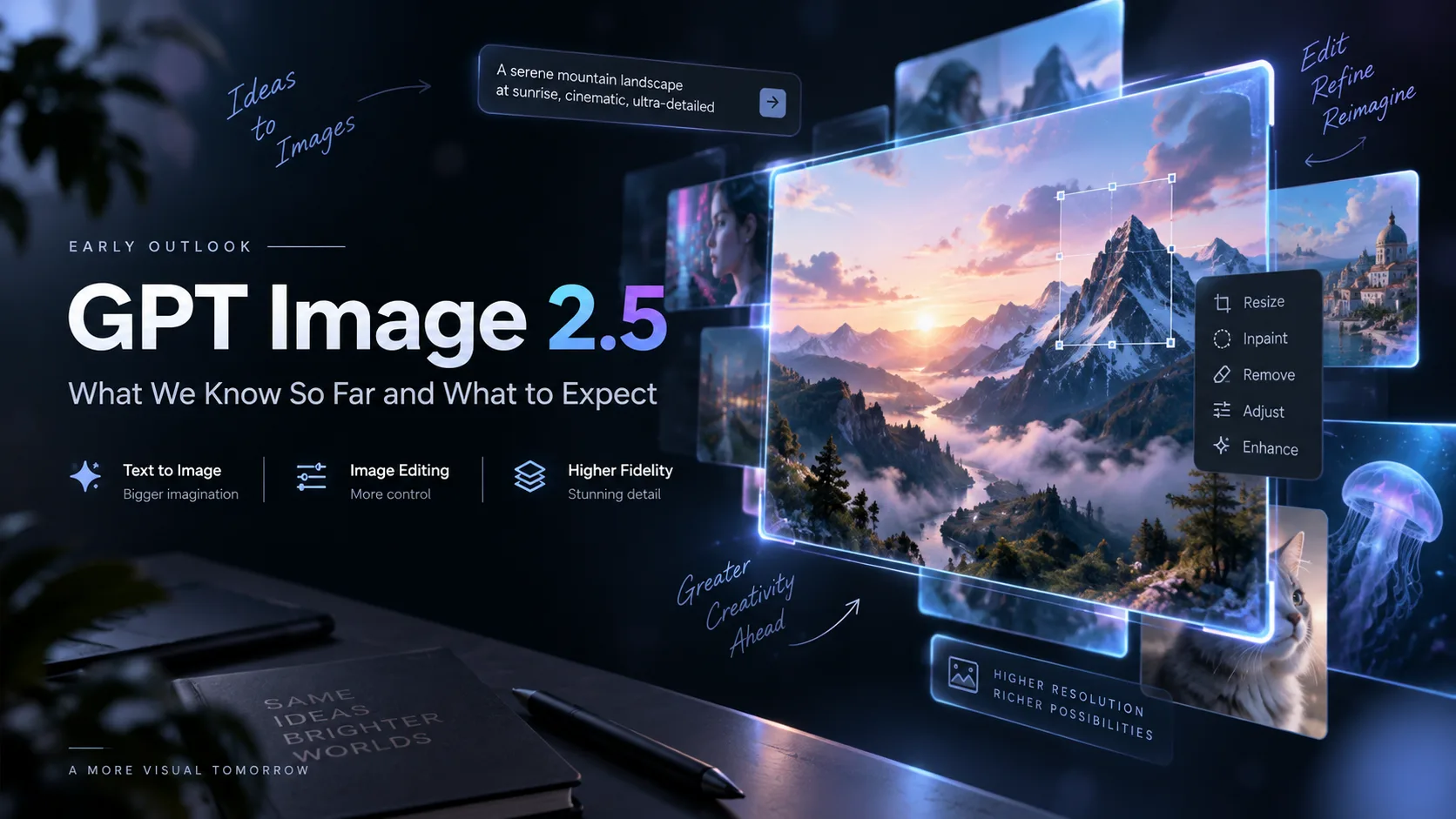
AI image generation is moving unusually fast in 2026. Better typography, more accurate prompt following, higher-resolution output, and increasingly reliable image editing are turning generative image models from experimental tools into practical creative software.
Now, attention is beginning to shift toward GPT Image 2.5, a name that has appeared increasingly often in AI communities over the past few weeks.
There is one important detail to establish first: OpenAI has not officially announced a model called GPT Image 2.5 yet. There is currently no official model card, API identifier, pricing page, or confirmed release date for it. OpenAI's publicly available flagship image model remains GPT Image 2, which launched in April 2026.
However, several recent signals suggest that OpenAI may already be testing its next major image-generation upgrade. Anonymous models appearing in image-model arenas, reported internal interface changes, and increasingly sophisticated test outputs have led many observers to believe that another GPT Image release may be approaching.
For creators who want to follow these developments closely, gptimage-2-5.com is already preparing a dedicated experience around the expected next generation of GPT-based image creation. The site is designed as a place to track the rollout and experiment with new image-generation capabilities as soon as they become available.
So what could GPT Image 2.5 actually bring to creators?
GPT Image 2 Already Changed the Baseline
To understand why GPT Image 2.5 is attracting attention, it helps to look at what GPT Image 2 already accomplished.
GPT Image 2 pushed OpenAI's image generation much further toward practical production work. Instead of simply creating attractive illustrations from short prompts, the model became significantly better at handling tasks involving structured layouts, text inside images, advertisements, UI concepts, diagrams, product visuals, and complex editing instructions.
This matters because professional image generation is less about producing one impressive picture and more about maintaining control.
A designer may need to change a headline without changing the model's face. An ecommerce team might want to replace a product while preserving the lighting and composition. A marketer may need the same campaign concept adapted into square, landscape, and vertical formats.
These workflows expose weaknesses that are easy to hide in simple text-to-image demonstrations.
A next-generation GPT Image model therefore does not necessarily need a completely new artistic style. It needs to become more predictable, more editable, and more consistent.
That is where GPT Image 2.5 could become especially interesting.
Why People Think GPT Image 2.5 May Be Coming
During August 2026, AI model watchers began reporting anonymous image-generation checkpoints appearing in Arena-style blind tests.
One of the first names to attract attention was mona-lisa-1. Later reports discussed another checkpoint called luna-lisa-alpha.
Neither name has been officially connected to OpenAI, and neither should be treated as a confirmed product name. Still, community testers have associated these models with improvements in areas such as realism, fine detail, prompt adherence, composition, text generation, and visual consistency.
The timing is also notable.
GPT Image 2 launched in April 2026, and several months of real-world use have now provided OpenAI with a large amount of feedback about what image-generation users actually struggle with.
More recently, reports surfaced of a hidden interface message referring to image creation receiving a "major upgrade," along with promises of higher-quality results, faster generation, and smarter creative tools.
Again, none of this confirms that the final product will actually be called GPT Image 2.5. It could ship under another name entirely.
But taken together, the signals make another image-generation update increasingly plausible.
Creators interested in getting hands-on access quickly can also keep an eye on GPT Image 2.5, where the upcoming workflow is being built around fast access to new text-to-image and image-to-image capabilities as they roll out.
What We Expect GPT Image 2.5 to Improve
If GPT Image 2.5 does become the next official model, the most valuable improvements may be less about dramatic benchmark numbers and more about eliminating small errors that currently interrupt professional workflows.
1. Even Better Text Inside Images
Text rendering has become one of the most important competitive areas for AI image models.
Older generators were excellent at creating attractive posters until you looked closely at the words. Misspelled headlines, distorted letters, inconsistent spacing, and invented characters often meant the final result still required Photoshop or manual reconstruction.
GPT Image 2 already improved this considerably.
GPT Image 2.5 could push the capability further, especially for longer headlines, menus, packaging, interface mockups, posters, advertisements, labels, diagrams, and multilingual content.
The real goal is not simply generating readable text. It is generating exact text in the correct location, size, hierarchy, and visual style.
That would make AI-generated images substantially more useful for commercial design.
2. Cleaner Repeated Editing
Generating an image once is easy. Editing the same image five or ten times without introducing unwanted changes is much harder.
This remains one of the biggest challenges across modern image models.
You might ask to change a shirt from black to blue, only to discover that the background has changed as well. Another edit might fix the background but slightly alter the person's face. After several iterations, the image can gradually drift away from the original.
A major GPT Image 2.5 improvement could therefore involve stronger multi-turn image consistency.
Ideally, creators would be able to say:
- Change only the headline.
- Move the product slightly to the left.
- Keep the person's face exactly the same.
- Replace the background with a studio interior.
- Make the logo 20% smaller.
Each edit would modify only what was requested while preserving approved areas of the image.
For professional workflows, this may be more important than raw image quality.
3. Stronger Reference-Image Understanding
Reference images are becoming central to AI image creation.
Instead of describing everything through text, users increasingly want to provide examples of a character, product, outfit, room, art direction, or visual identity and ask the model to build something new around them.
The next GPT Image generation could make these workflows much more reliable.
For example, creators may eventually be able to combine multiple references for different purposes: one image for the subject, another for clothing, another for lighting, another for composition, and several more for products or environmental details.
Larger multi-reference workflows would be especially useful for ecommerce, advertising, character design, game assets, storyboards, and branded content.
4. Sharper High-Resolution Output
Resolution is another obvious area for improvement.
AI-generated images are increasingly being used for real marketing materials rather than just social media experiments. That means creators want outputs suitable for website hero sections, advertisements, product pages, presentations, print assets, and large displays.
Higher native resolution can preserve small typography, textures, hair, skin detail, product labels, architecture, and interface elements far better than simply enlarging a low-resolution result afterward.
A GPT Image 2.5-class model could make high-resolution generation a more standard part of the workflow, reducing dependence on separate AI upscalers.
5. Better Realism Without the "AI Look"
Photorealism is already strong, but subtle artifacts remain surprisingly easy to recognize.
Skin may be too smooth. Objects may have slightly incorrect geometry. Background details can repeat. Clothing textures can become inconsistent. Complex hands or accessories may still break under close inspection.
Recent experimental image models suggest that the industry is now concentrating heavily on these subtle issues.
Rather than merely making images "more detailed," the next step is likely to involve making detail more physically believable.
That means natural skin, believable materials, accurate reflections, coherent lighting, less artificial sharpening, and fewer repeated textures.
GPT Image 2.5 Could Become More of a Design Tool Than an Image Generator
The larger trend behind all of these improvements is important.
AI image models are gradually changing from one-shot generators into interactive visual design systems.
The traditional workflow was:
Prompt → Generate → Download
The emerging workflow looks more like:
Prompt → Generate → Analyze → Edit → Add references → Refine layout → Correct text → Create variations → Export
That difference changes who can use the technology.
A marketing team could create an entire advertisement without switching between multiple applications. A founder could produce launch graphics without hiring a designer for every iteration. A developer could create polished UI concepts directly from product requirements. An ecommerce seller could turn basic product photos into multiple campaign assets.
GPT Image 2.5 could accelerate this transition if it significantly improves editing consistency and instruction accuracy.
GPT Image 2.5 vs GPT Image 2: What Could Change?
Until OpenAI publishes official specifications, any detailed comparison remains speculative.
Still, based on the direction of GPT Image 2 and the weaknesses that remain in current-generation image models, the priorities for a GPT Image 2.5 update are relatively clear.
We would expect improvements around:
- More accurate prompt interpretation
- More reliable typography
- Better small-text rendering
- Cleaner repeated edits
- Stronger preservation of faces and objects
- Improved reference-image consistency
- More realistic skin, materials, and lighting
- Better complex layouts
- Faster iteration
- Higher-resolution production workflows
- More dependable text-to-image and image-to-image generation
The most successful upgrade would not simply generate prettier images. It would require users to regenerate images less often.
That is ultimately what makes an AI creative tool valuable.
When Will GPT Image 2.5 Be Released?
There is currently no confirmed GPT Image 2.5 release date.
Any specific date circulating online should therefore be treated as speculation unless it comes directly from OpenAI.
What can be said is that the recent testing activity appears consistent with a model that is actively being evaluated.
Anonymous Arena checkpoints are commonly used to compare experimental models before a wider launch, and the appearance of several new image-focused candidates within a relatively short period suggests that development is continuing quickly.
Whether the final release arrives as GPT Image 2.5, GPT Image 3, a new ChatGPT Images update, or something with an entirely different name remains unknown.
Final Thoughts
GPT Image 2 already demonstrated how quickly AI image generation is moving from novelty toward production.
The next upgrade may be less about generating visually impressive images for demonstrations and more about solving the practical problems creators encounter every day: misspelled text, inconsistent characters, unintended changes during editing, weak small details, layout drift, and limited control over complex scenes.
If GPT Image 2.5 can meaningfully reduce those problems, it could become an important step toward AI image generation that feels less like repeatedly rolling the dice and more like working with an intelligent visual editor.
For now, the most important distinction is simple: GPT Image 2.5 is still an anticipated model, not an officially announced OpenAI product.
But the recent signals are enough to make it worth watching.
And if the next generation delivers stronger text accuracy, cleaner repeated edits, better reference handling, higher-resolution results, and greater visual consistency, GPT Image 2.5 could become one of the most useful AI image-generation upgrades of 2026.